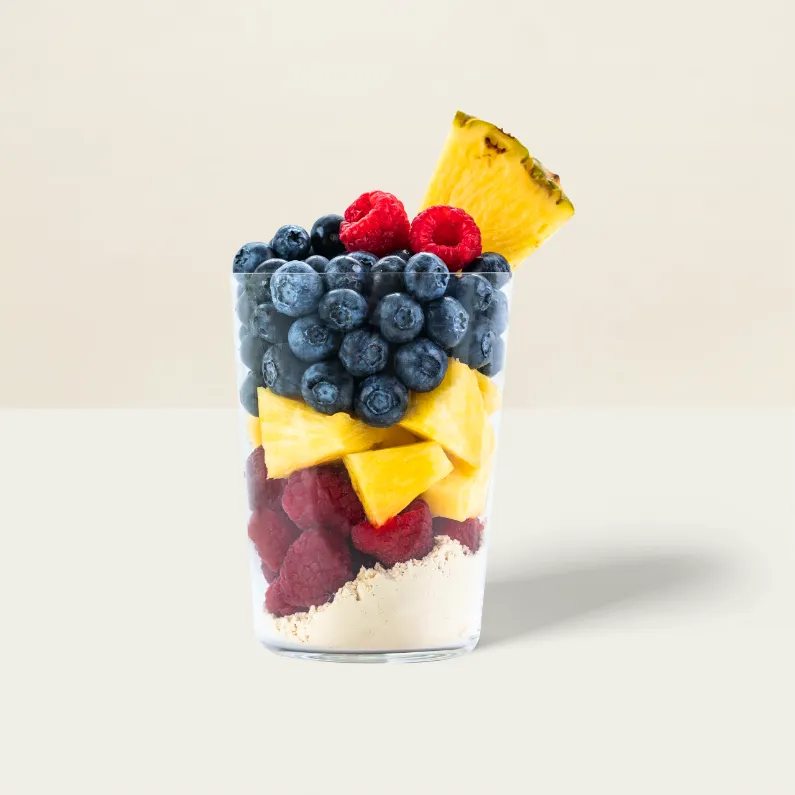
Spirulina can contribute color and, depending on its form and quantity, nutrients to a smoothie, but its role changes between whole spirulina powder and blue spirulina extract. Our Blueberry & Spirulina smoothie shows how spirulina can fit into a fruit-led blend without defining the entire drink’s nutritional value.
So, what is spirulina good for when you are choosing breakfast or a snack? The useful answer starts with three details: which form is included, how much is used and what else goes into the blender.
A blue drink is not automatically high in protein. A green powder does not automatically improve every recipe. Understanding those tradeoffs helps you choose a smoothie for reasons that go beyond its appearance.
What Is Spirulina?
Spirulina is an edible cyanobacterium commonly described as blue-green algae. It is sold in several forms, including dried whole powder and extracts used in foods, so the word on its own does not tell you exactly what a product contains.
Whole spirulina powder includes the dried biomass. Products marketed as blue spirulina generally focus on an extract rich in phycocyanin, the pigment responsible for the striking blue color.
These forms are related, but they are not interchangeable in a recipe or nutrition comparison. Before expecting a particular benefit, check the actual ingredient description and the finished product’s label.
What Is Spirulina Good For in a Smoothie?
Spirulina’s most visible contribution is color, while its nutritional contribution depends on the form and serving. In a finished smoothie, it works alongside the fruit, vegetables, seeds and any dedicated protein ingredients.
Whole spirulina contains protein and other nutrients, but a small amount of powder is still a small food portion. Research describing nutrients in dried spirulina does not mean every smoothie containing it supplies a substantial amount of those nutrients.
For your everyday choice, separate three questions:
- Does the ingredient create a color or flavor you enjoy?
- What does the complete smoothie provide per serving?
- Does that serving fit the snack or meal you have planned?
Those questions give you more practical information than an ingredient’s reputation alone.
Blue Spirulina and Green Spirulina Have Different Jobs
Blue spirulina extract emphasizes pigment, while whole green spirulina powder brings a broader mixture of the original biomass. That difference affects appearance, flavor and what you can reasonably infer about nutrition.
| Feature |
Whole spirulina powder |
Blue spirulina extract |
| Form |
Dried biomass |
Extract centered on the blue pigment |
| Typical appearance |
Dark green to blue-green |
Bright blue |
| Flavor consideration |
May add earthy or algae-like notes |
Flavor varies with the product and formulation |
| Nutrition comparison |
Depends on the amount consumed |
Cannot be assumed equivalent to whole powder |
| Best information source |
Its own label and serving directions |
Its own label and serving directions |
A bright blue smoothie may look lighter or more playful than a dark green blend. That visual difference does not rank their nutritional quality. Read the finished drink’s protein, fiber and other relevant nutrients separately.
Flavor Is the Tradeoff You Notice First
Whole spirulina can introduce earthy or algae-like flavors that become more noticeable as its concentration increases. Food formulation research has observed these sensory challenges, which makes flavor balance a practical consideration rather than an afterthought.
A smoothie still needs to taste good enough for you to want it again. Fruit choice, acidity, creaminess and powder quantity all affect that experience.
Fruit Creates the Main Flavor Direction
Fruit gives a spirulina smoothie a familiar flavor base. Pineapple, berries and banana offer different combinations of sweetness, tartness and body.
Choose a direction you already enjoy before experimenting with an unfamiliar ingredient. A pineapple-led blend feels different from a creamy banana drink, even when both contain spirulina. Start with that personal flavor preference instead of trying to hide a flavor you dislike beneath several extra sweeteners.
Citrus Changes the Balance
Lime and other citrus ingredients add acidity that can sharpen a fruit blend’s flavor. They provide another way to adjust the overall taste without simply adding more sweetness.
The effect still depends on the recipe. More citrus can make an already tart drink too sharp. Treat it as a measured flavor adjustment, especially when your smoothie already contains pineapple or berries.
Texture Changes the Experience
The amount of liquid and the other ingredients determine whether a spirulina smoothie feels thick, creamy or refreshing. A powder cannot be judged separately from the drink carrying it.
Follow the product’s preparation directions first. If you change the liquid, use a small adjustment and blend again. This lets you find the texture you like without adding several ingredients whose effects are difficult to separate.
Read Our Blueberry & Spirulina Label as a Whole
Our Blueberry & Spirulina smoothie combines fruit, vegetables and several smaller additions into one frozen blend. Its ingredient list includes pineapple, banana, zucchini, cauliflower, raspberries, blueberries, lime juice powder, blue spirulina, pea protein, vanilla, chia seeds and hemp protein.
The published nutrition panel lists 150 calories, 5 g of fiber and 3 g of protein per package before you add liquid. That protein figure is especially useful: the presence of spirulina and protein ingredients does not make this a high protein smoothie.
Its role may be a fruit-led snack or part of a larger breakfast, depending on your needs. Check your package for current values, then include the contribution of whatever liquid or additions you use.
Spirulina Does Not Replace a Dedicated Protein Choice
A protein-focused smoothie needs enough total protein for its intended role, regardless of whether spirulina appears in the ingredient list. Counting ingredient names is less useful than checking the grams per serving.
If protein is your priority, compare a blend with a clearly identified protein source, such as our High Protein Berry smoothie, rather than assuming a spirulina option will do the same job.
At home, yogurt, an appropriate milk base or a suitable protein powder can change the total. Read those labels too. More additions are not automatically necessary, and the best choice depends on what the original blend already provides and what else you plan to eat.
Keep Spirulina Health Claims in Perspective
Spirulina research does not justify treating an ordinary smoothie as a treatment for inflammation, high cholesterol or another medical condition. Studies of particular supplements and doses cannot automatically establish benefits for a different food containing an unspecified amount.
The same caution applies to vitamin B12. France’s food safety agency, ANSES, identifies spirulina as an unreliable B12 source because much of its B12-like material is an inactive analogue. People following a vegan diet need a reliable B12 source rather than depending on a spirulina drink.
You can enjoy the ingredient without assigning it a therapeutic role. A smoothie can contribute to an eating routine through its actual food content, taste and convenience. Those are useful benefits without promising a medical outcome.
Choose Spirulina Products With Clear Information
Clear labels and trustworthy supply channels matter when buying a spirulina powder or supplement. Blue-green algae products can raise contamination concerns, so product identity and quality information deserve attention.
For an at-home powder, look for:
- A clear description of the product and its form.
- Serving directions specific to that product.
- An identifiable manufacturer and contact information.
- Available quality or contaminant-testing information.
Use the labeled serving directions rather than assuming a teaspoon is a universal dose. If you are considering a supplement while pregnant, breastfeeding or managing a medical condition, ask your healthcare professional whether it is suitable.
A premade food and a concentrated supplement are different purchases. Evaluate each according to its own label and intended use.
Frequently Asked Questions About Spirulina Smoothies
Spirulina smoothie questions usually concern taste, protein and how much to add. The product’s form and label provide the starting point for each answer.
Does Spirulina Make Every Smoothie Taste Earthy?
Whole spirulina can add earthy notes, but the taste of a finished smoothie depends on its form, quantity and other ingredients. Blue spirulina extract should not be assumed to taste identical to whole green powder.
How Much Spirulina Should I Add?
Follow the serving directions on your particular spirulina product. Different forms and concentrations make a universal scoop recommendation unreliable. If a premade smoothie already includes spirulina, you do not need to add more to complete the recipe.
Is a Spirulina Smoothie a Meal Replacement?
A spirulina smoothie is not automatically a meal replacement. Its energy, protein and overall composition determine whether it is substantial enough for your needs. The ingredient name alone cannot answer that question.
Find a Spirulina Blend That Fits Your Routine
Revive Superfoods offers frozen smoothie options that let you choose by flavor and nutrition together. Spirulina can be one part of that decision, alongside the portion, preparation and complete ingredient list.
Explore Revive Superfoods to compare blends that fit the way you eat. Start with a fruit profile you enjoy, check the nutrition panel and choose your liquid deliberately. The goal is a smoothie you understand, enjoy and can easily make again.