The filling smoothie ingredients we come back to are not one magic fruit or powder. We look at the whole recipe: protein, fiber-rich fruits or vegetables, seeds or nuts, and sometimes healthy fats, then consider flavour and texture so the finished smoothie is something you actually want to drink.
That sounds obvious until you compare real smoothies.
At Revive Superfoods, our smoothie menu currently ranges from a 34-gram High Protein Mocha to a Blueberry & Raspberry blend with 10 grams of plant protein and 9 grams of fiber, plus Tropical Greens Fiber with avocado, spinach, chia, and 7 grams of fiber.
Those recipes are different because fullness does not have to come from exactly the same ingredient combination every time.
What Ingredients Make a Smoothie More Filling?
Protein, fiber, and healthy fats are the main components we consider when building a more satisfying smoothie, while fruits and vegetables add carbohydrates, fiber, flavour, texture, vitamins, minerals, and variety.
The balance depends on the job of the smoothie.
A post-workout cup may put more emphasis on protein. A lighter greens smoothie can lean harder on fiber-rich plants. A breakfast blend may combine fruit, protein, nuts, and seeds.
Protein Gives the Smoothie More Staying Power
Protein is one of the first things people look for when they want a smoothie to feel more substantial.
Common protein smoothie ingredients include whey protein, pea protein, Greek yogurt, dairy or soy milk, nuts, seeds, and nut butters.
In our own menu, we use different approaches.
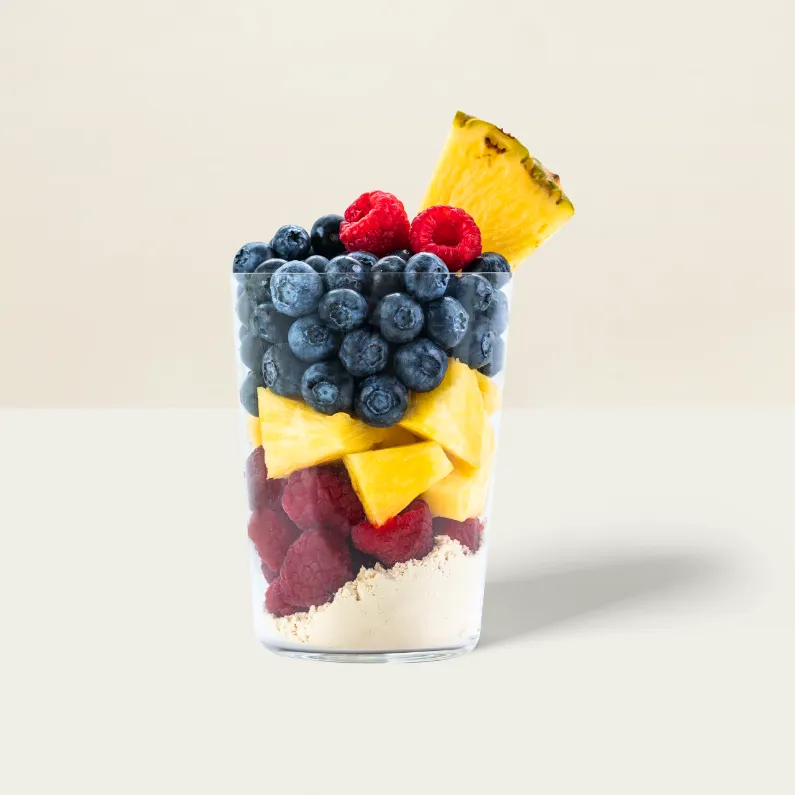
High Protein Berry combines pineapple, blueberries, raspberries, and vanilla whey protein and currently provides 26 grams of protein.
Blueberry & Raspberry goes plant-based instead, pairing its fruit with pea protein and hemp heart seeds.
The point is not that every smoothie needs the largest protein number available.
It is knowing when protein is one of the things you want the cup to deliver.
Fiber Can Come From More Than Greens
People often associate fiber with spinach or kale, but fiber-rich smoothies can get it from several ingredient families.
Berries, chia seeds, flax seeds, avocado, vegetables, psyllium husk, nuts, and other plant foods can all contribute.
That gives recipe development more flexibility.
You do not have to make every fiber-focused smoothie taste like a green smoothie.
What Have We Learned From Pairing Protein and Fruit?
Fruit makes protein smoothies easier to build because it contributes flavour, sweetness, acidity, texture, and carbohydrates while giving us room to pair the protein source with different flavour profiles.
Berries Work Well With Both Whey and Plant Protein
Berries appear repeatedly across our recipes for a reason.
Blueberries, raspberries, strawberries, and cherries can move from bright and tart to richer dessert-inspired profiles depending on what surrounds them.
Our whey-based High Protein Berry pairs berries and pineapple with vanilla whey.
Our Blueberry & Raspberry blend uses raspberries, strawberries, blueberries, pineapple, and blackberries with pea protein, hemp hearts, and açaí.
It currently provides 10 grams of plant protein and 9 grams of fiber.
Two berry smoothies can therefore solve very different nutritional and flavour goals.
Banana Can Do More Than Add Sweetness
Banana is useful because it contributes body and sweetness, which can help a protein-heavy recipe taste and feel more complete.
Look at our High Protein Mocha.
Banana sits alongside almonds, chocolate whey protein, cocoa, and coffee. The current cup contains 34 grams of protein and 5 grams of fiber.
We are not relying on banana to make the smoothie filling by itself.
It is part of a larger structure.
That is an important distinction when choosing smoothie ingredients for fullness. Ask what the ingredients are doing together rather than trying to identify one “most filling” fruit.
How Do We Use Seeds in Filling Smoothies?
Seeds can contribute fiber, protein, fats, texture, and nutrients without requiring a smoothie to become heavy or nut-butter-forward.
Chia, flax, and hemp hearts appear in different Revive recipes.
Chia and Flax Work Well in Fruit-Forward Blends
Our Strawberry & Banana smoothie includes both flax seeds and chia seeds alongside banana, strawberries, raspberries, zucchini, peaches, pea protein, and cranberry powder.
Those seeds allow a familiar strawberry-banana flavour to carry a more varied ingredient list.
This is part of how we think about satisfying smoothies.
You should not have to choose between “functional” and “actually tastes like something I want for breakfast.”
Hemp Hearts Pair Naturally With Plant Protein
Hemp heart seeds appear in Blueberry & Raspberry alongside pea protein.
That creates another way to build protein and fiber smoothies without defaulting to whey in every cup.
It also matters for variety.
If you drink smoothies regularly, having only one protein source and one flavour profile can make the routine repetitive quickly.
Where Do Healthy Fats Fit Into a Smoothie?
Healthy fats in smoothies can come from ingredients such as avocado, almonds, chia, flax, hemp hearts, nut butters, and coconut, depending on the recipe.
We use them when they make sense for both nutrition and texture.
Avocado Can Change the Texture Without Taking Over the Flavour
Avocado is one of our favourite examples because it can make a blend feel creamier without turning it into an avocado-flavoured drink.
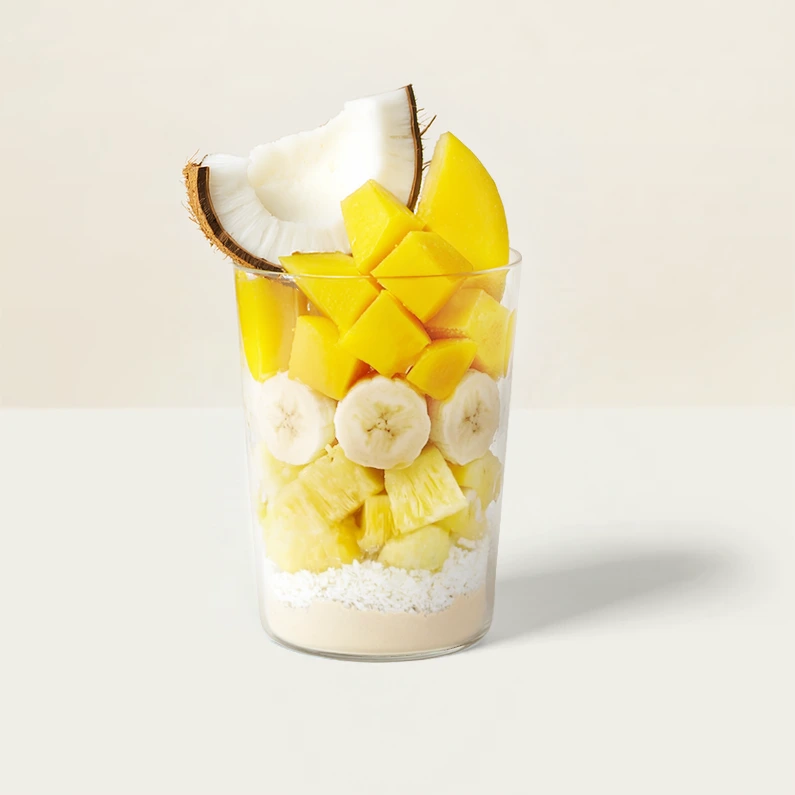
Tropical Greens Fiber combines pineapple and banana with avocado, spinach, chia seeds, and shredded coconut.
The pineapple keeps the blend bright. Avocado contributes creaminess. Spinach adds greens. Chia helps build the fiber side of the recipe.
The current cup contains 7 grams of fiber.
This is a good example of why we prefer combinations to isolated “superfood” thinking.
Almonds Can Support Both Texture and Substance
In High Protein Mocha, almonds sit alongside banana, whey protein, cocoa, and coffee.
They help move the blend toward a richer, nuttier profile while also contributing fat, fiber, and texture.
A recipe ingredient should ideally earn its place more than one way.
Does More Protein Automatically Make a Smoothie More Filling?
Not necessarily. Protein is important for satiety, but the overall recipe, portion, fiber, fat, liquid choice, and individual needs matter too.
That is why we do not rank our smoothies from “least filling” to “most filling” based on protein alone.
A 34-gram protein smoothie serves a different purpose from a 7-gram-fiber tropical greens cup.
Decide Whether the Smoothie Is a Snack or a Meal
This is one of the most practical distinctions you can make.
If you want a lighter afternoon smoothie, your priorities may be fruit, hydration, flavour, and moderate nutrition.
If the smoothie is standing in for breakfast after a workout, you may want to look much more closely at protein and total nutritional composition.
Our High Protein Smoothie Box is built for the second type of shopper, with several higher-protein recipes plus a plant-protein option.
The label should help you make the distinction.
What About the Liquid You Add?
The blending liquid can change flavour, texture, calories, protein, and the overall nutritional profile of the finished smoothie.
Water keeps things simple.
Dairy milk or some soy milks can add protein. Coconut water changes a tropical blend differently from almond milk. Other plant milks vary substantially by product.
We test our recipes with different liquids and publish a liquid guide for Revive smoothies because the best pairing is not identical for every cup.
High Protein Mocha currently pairs with almond milk in our guide, while Blueberry & Raspberry and Tropical Greens Fiber pair with coconut water.
You can still customize.
The recommendation is simply the flavour and texture starting point we have already tested.
How Should You Read a Smoothie Ingredient List for Fullness?
Start by locating the protein source, then look for fiber-rich plant foods and sources of fat. After that, consider the total nutrition facts and whether the recipe fits what you want the smoothie to do.
A simple checklist is:
- What is providing the protein?
- Which ingredients contribute fiber?
- Is there a nut, seed, avocado, or another source of fat?
- Is the blend mostly fruit, or does it include vegetables too?
- What does one full package provide?
- What liquid will you add?
- Is this intended to be a snack, breakfast, or post-workout option?
- Will you actually enjoy the flavour enough to order it again?
That last question deserves more attention.
The most theoretically perfect breakfast is not especially useful when it stays at the bottom of the freezer.
We Build Filling Smoothies as Complete Recipes
At Revive Superfoods, what we have learned from building protein, fruit, greens, and fiber-focused recipes is that fullness is easier to think about as a structure than as a single ingredient.
Protein matters.
Fiber matters.
Healthy fats can matter.
Fruit, vegetables, seeds, nuts, and the liquid you choose all affect the final cup too.
That is why our filling smoothie ingredients change from recipe to recipe. High Protein Berry leans on whey and fruit. Blueberry & Raspberry combines berries, pea protein, and hemp hearts. Tropical Greens Fiber approaches the problem with avocado, spinach, chia, coconut, and fruit. High Protein Mocha goes in an entirely different direction with whey, almonds, banana, cocoa, and coffee.
Different mornings need different blends.
Instead of searching for the one ingredient that makes every smoothie filling, build or choose a recipe where the ingredients make sense together.
That is how we approach the blender.